


Which Crypto Exchange Has the Lowest Fees?
A complete breakdown of fee structures, from maker-taker models to network costs, to help you trade smarter.
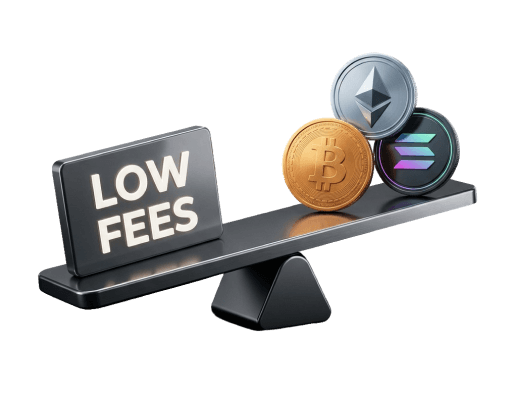
Understanding the Different Types of Crypto Exchange Fees
Trading cryptocurrency involves more than just the price of the asset. Every transaction comes with costs, and they show up in various forms. The most direct cost is the trading fee, a percentage of your trade value charged for executing the order. Beyond that, you'll encounter withdrawal fees for moving assets off the platform and sometimes deposit fees for adding funds. Some platforms also have fiat conversion fees when you swap traditional currency for crypto.
The spread is the difference between the highest price a buyer will pay (bid) and the lowest price a seller will accept (ask). Exchanges can profit from this gap, making it a subtle but significant fee that isn't always listed on their fee schedule.
For more complex activities, other costs appear. Using leverage can introduce margin interest, and if a position is forcibly closed, you might face liquidation fees. On some networks, moving crypto requires paying blockchain gas fees to miners or validators. Understanding this complete picture, from obvious trading fees to hidden spread fees, is the first step toward managing your costs effectively.

Maker vs. Taker Fees: What's the Difference and Why It Matters
Most major exchanges use a maker-taker model to determine their fees, a system designed to encourage market activity. Think of it like a physical marketplace. A 'maker' is the vendor who sets up a stall and puts a price tag on their goods, adding inventory for others to browse. A 'taker' is the shopper who walks in and buys an item at the listed price, removing it from the market. In trading, makers create liquidity by placing limit orders that don't fill immediately. Takers remove liquidity by placing market orders that execute instantly at the current best price.
Providing liquidity is the lifeblood of any market. Exchanges reward makers with lower fees because their orders create a more robust and stable trading environment for everyone else.
This fee structure matters because your trading style directly impacts your costs. By using limit orders, you act as a maker and usually pay a lower fee. Some high-volume traders on certain VIP volume tiers may even receive rebates for their maker activity. Conversely, prioritizing speed with market orders makes you a taker, which almost always results in a higher fee. Many platforms also offer an exchange token discount, further reducing costs for both makers and takers who hold the exchange's native asset.
Comparing Fee Structures of Major Crypto Exchanges
No two crypto exchanges are identical in how they charge for services. Their approaches generally fall into a few categories. The most common is the fee tier system, where your trading fees decrease as your 30-day trading volume increases. This model rewards active, high-volume traders. Another common approach is a flat fee structure, where everyone pays the same percentage regardless of how much they trade. This can be simpler for casual users but less economical for frequent traders.
Fees decrease as your trading volume increases.
A single fee percentage applies to every user.
Holding an exchange's token reduces your fees.
Many exchanges also build a loyalty program around their native token, offering significant native token discounts to users who hold it or use it to pay fees. Finally, keep an eye out for promotions. To attract users, platforms might offer zero spot trading maker fees on specific pairs like BTC or ETH for a limited time. When choosing, consider your expected trading volume and whether you plan to engage with the platform's ecosystem to find the most suitable model.
Centralized vs. Decentralized Exchanges: A Fee Perspective
The world of crypto trading is split between centralized exchanges (CEXs) and decentralized exchanges (DEXs), and their fee structures are fundamentally different. A CEX operates like a traditional company, setting its own maker/taker trading fees, deposit and withdrawal fees, and other charges. These fees are generally predictable and clearly outlined on their website.
DEXs are another story. They run on smart contracts, and their costs are driven by the underlying blockchain. The primary cost is network gas fees, which are paid to validators to process your transaction. These transaction fees can be low or extremely high depending on network congestion. On top of gas, you pay a protocol fee to the liquidity providers. A significant hidden cost on DEXs is slippage—the difference between the expected price of a trade and the price at which it's executed. On assets with low liquidity, slippage can cost you more than any explicit fee.
- Predictable and published rates.
- Often lower for small, frequent trades.
- Fiat on/off-ramp options are integrated.
- Highly variable based on network traffic.
- Slippage can be a major hidden cost.
- Gas fees can make small trades uneconomical.
Actionable Strategies to Reduce Your Crypto Trading Fees
Paying trading fees is unavoidable, but you can be strategic about minimizing them. Simple changes in how you trade can lead to significant savings over time. The most effective methods involve understanding the fee schedule of your chosen exchange and aligning your activity with its incentive structures. This could mean changing the type of orders you place, taking advantage of platform-specific programs, or consolidating your trading to reach higher volume tiers.
Become a Market Maker
Instead of placing market orders that execute instantly, use limit orders. This places you in the 'maker' category, which almost always comes with lower fees. It requires more patience but directly cuts your costs on every trade.
Leverage Native Token Discounts
Many exchanges offer discounts of 25% or more if you hold their native token or use it to pay fees. If you're a frequent trader on one platform, this is one of the easiest ways to get a permanent fee reduction.
Climb the Volume Tiers
If you trade on multiple exchanges, consider consolidating your high-volume trading on a single platform. Crossing the threshold into a new tier in a tiered fee structure can dramatically lower your rates.
Look for Promotions
Exchanges often run zero-fee events for specific trading pairs to attract volume. Keep an eye out for these promotions to execute large trades with no commission.
Beyond Fees: Other Critical Factors for Choosing an Exchange
While low fees are attractive, they are just one piece of the puzzle. The cheapest exchange is not always the best or safest choice. A truly great platform balances competitive costs with robust security, a great user experience, and regulatory adherence. Before committing to an exchange based on its fee schedule, consider other factors that can have a much greater impact on your trading experience and the safety of your funds. High liquidity, for example, ensures you can execute large trades without significant price impact, which can save you more than a low fee would.
Similarly, strong security features are non-negotiable. Look for platforms that offer proof of reserves, maintain crime insurance, and have a long track record without major security breaches. The user interface, availability of advanced trading features, and the range of cryptoassets are also important. The right exchange for you will depend on your personal priorities across all these areas, not just cost.
| Factor | Why It Matters | What to Look For |
| Security | Protects your assets from theft and hacks. | Proof of Reserves, 2FA, Insurance Fund. |
| Liquidity | Ensures fair pricing and fast trade execution. | High trading volumes on major pairs. |
| Regulation | Provides a safer trading environment and legal recourse. | Compliance with local financial authorities. |
| Asset Selection | Access to the markets you want to trade. | Wide range of reputable tokens and pairs. |
How Crypto Trading Fees Can Impact Your Tax Reporting
Trading fees are not just a cost of doing business; they also play a role in your tax obligations. In many jurisdictions, these fees can be used to adjust the cost basis of your crypto assets. The cost basis is essentially what you paid to acquire an asset. When you include trading fees in this calculation, you increase the basis. This is beneficial because when you eventually make sell transactions, your taxable capital gains are calculated as the sale price minus the cost basis. A higher basis means lower taxable gains.
This principle generally applies to direct trading fees, but can sometimes extend to fiat conversion fees and even withdrawal fees if they are a necessary part of acquiring the asset. Keeping meticulous records of every transaction and its associated fees is vital. While spreads are also a cost, they are often harder to document as they are embedded in the trade price. Using a crypto tax calculator can help automate this process, ensuring you accurately account for fees and correctly calculate your taxable gains or losses without navigating the complex rules of capital gains tax (CGT) on your own.
Frequently asked questions
-
Are 'zero-fee' exchanges really free?
Not usually. Exchanges that advertise zero fees often make money through other means. The most common is by building a wider spread between the bid and ask prices, which is a hidden fee. They may also have higher withdrawal fees, fiat conversion fees, or other costs that make up for the lack of a direct trading commission. -
Is it cheaper to use a centralized or decentralized exchange?
It depends. For small, frequent trades, a centralized exchange (CEX) is often cheaper due to its predictable, low-percentage fees. For very large trades, a decentralized exchange (DEX) might be cheaper if the network gas fee is low, but costs can become extremely high during periods of network congestion. Slippage on DEXs can also be a significant hidden cost. -
How can I calculate my total trading cost on a transaction?
To calculate your total cost, start with the stated trading fee (e.g., 0.1% of the trade value). Then, check the spread between the buy and sell price; a wider spread means a higher implicit cost. Finally, factor in any deposit or withdrawal fees required to get your funds on and off the platform. The sum of these gives you a more complete picture of your total cost. -
Do I pay fees even if my trade loses money?
Yes. Trading fees are charged by the exchange for executing your order, regardless of the trade's outcome. The fee is calculated based on the total value of the transaction at the time of execution, so you will pay it whether the trade ultimately results in a profit or a loss. -
What is the single biggest factor that determines my trading fee rate?
On most modern exchanges, your 30-day trading volume is the single biggest determinant of your fee rate. Exchanges use tiered systems that reward higher-volume traders with lower maker and taker fees. Consolidating your trading activity on one platform is a common strategy to increase your volume and qualify for lower fee tiers.
Crypto guides
Beginner-frendly
The Informational Guide to Trading Mechanics Understand the foundational concepts, systems, and structures that drive global financial markets
 Farouk Ahmed
|
Farouk Ahmed
|
Intraday Trading Mechanics Analyzing the technical execution, risk parameters, and software infrastructure behind daily market operations.
 Alexey Morozov
|
Alexey Morozov
|
How to Put Day Trading Profits Under an EIN An objective breakdown of transitioning from retail market participation to operating a structured commercial entity.
 Oliver Grant
|
Oliver Grant
|

Our website uses cookies. Our Cookie Policy