


AI and Crypto Trading: Your Guide to the New Age of Digital Assets
Discover the technology behind AI-powered trading, from machine learning algorithms to automated risk management, and understand its impact on modern crypto markets.
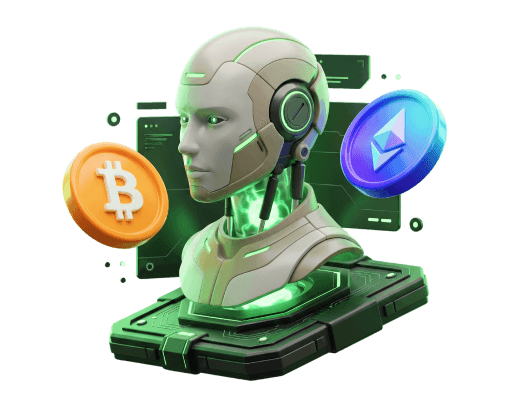
The New Frontier: What is AI in Cryptocurrency Trading?
AI crypto trading represents a significant evolution in how market participants interact with digital assets. It involves the use of sophisticated AI technology, particularly machine learning, to analyze vast datasets and execute trades. This is fundamentally different from simpler automated bots that follow rigid, pre-programmed rules. An AI system learns from new information and adapts its approach over time. The high-volume, 24/7 nature of cryptocurrency markets makes them an ideal proving ground for such systems. These AI-based financial services, like those developed by Algosone, are designed to manage a diverse asset portfolio. This can include not only major cryptocurrencies like Bitcoin and Ethereum but also a wide range of altcoins, price-pegged stablecoins, and even highly volatile memecoins, providing a comprehensive approach to navigating the complex world of crypto assets.

Inside the Machine: How AI Trading Systems Truly Operate
At its core, an AI trading system functions through a continuous, multi-stage process. It begins with massive data ingestion, pulling in a constant stream of market data such as price action, trading volume, and order book depth. This quantitative information is often combined with qualitative data, including social media sentiment, breaking news, and on-chain blockchain metrics. Next, powerful machine learning algorithms sift through this information to identify complex patterns and subtle correlations that are invisible to the human eye. During a crucial 'training' phase, these models are fed historical data, allowing them to learn the characteristics of successful and unsuccessful trade patterns. This enables the system to perform predictive analytics, forecasting potential price movements with a degree of statistical probability. By operating on pure data and logic, these systems effectively remove the emotional component of trading, such as fear or greed, which can often lead to suboptimal decisions.
AI-Driven Strategies for Enhancing Portfolio Growth
AI systems employ a range of sophisticated strategies aimed at identifying opportunities for portfolio growth. These methods go far beyond simple buy-and-hold tactics. For example, AI is particularly effective at high-frequency trading (HFT), where it executes a large number of orders in fractions of a second to capitalize on tiny price fluctuations. Another common strategy is arbitrage, where the AI simultaneously scans multiple exchanges to find price discrepancies for the same crypto asset, buying low on one and selling high on another. Advanced platforms using AI crypto trading models, such as Algosone, can also perform complex trend analysis, identifying emerging market momentum to determine potential entry and exit points. Furthermore, they can automate portfolio rebalancing, systematically adjusting the allocation of assets to maintain a target risk profile or to capitalize on changing market dynamics across thousands of potential crypto assets.
Automated Defense: AI-Powered Risk Management in Volatile Markets
In the volatile world of crypto, managing risk is paramount. A crypto trading bot powered by a refined machine learning algorithm can execute intricate strategies for capital preservation with a speed and discipline humans cannot match. A key function is the implementation of user-defined risk parameters; the user sets their tolerance for loss, and the AI operates strictly within those limits. It uses fundamental tools like automated stop orders to cap potential losses on a position and limit orders to secure a specific price for a trade. More advanced systems can deploy smart hedging tools, which might involve taking a counter-position in a correlated asset to offset potential downturns. Constantly performing technical analysis on incoming market data, the AI watches for signs of unusual volatility or sudden price swings. This allows it to adjust its approach in real-time, functioning much like dedicated risk management specialists to protect the portfolio from adverse market conditions.
The Human-AI Partnership: Your Role in the Process
Utilizing AI in trading is not a passive activity but rather a strategic partnership. The technology is a powerful tool for execution and analysis, not an autonomous entity that works in a vacuum. The user's role remains central to the process, focused on high-level strategic direction. It is the human who defines the overarching investment goals, determines the acceptable level of risk, and selects the broad strategies the AI will employ. The AI’s function is to then implement that strategy with maximum efficiency, analyzing market data and executing trades at a scale and speed that is humanly impossible. This collaborative model requires periodic oversight. Users should regularly review the AI's performance reports and be prepared to adjust their high-level parameters in response to shifting market dynamics or changes in their own financial objectives. In this partnership, the human provides the strategic 'why,' while the AI delivers the tactical 'how'.
Acknowledging the Realities: Risks and Limitations of AI Trading
It is essential to have a balanced perspective on the capabilities of AI in trading. Critically, AI does not and cannot guarantee profits. The cryptocurrency markets are inherently volatile, and all trading activities carry the risk of financial loss. An AI’s effectiveness is entirely dependent on the quality of its model and the data it was trained on; past performance is never an indicator of future results. These systems may also struggle with 'black swan' events—unprecedented market shocks caused by things like major regulatory changes or security breaches, which fall outside their historical data experience. Furthermore, there are technical risks to consider, such as platform downtime, software bugs, or connectivity issues with exchanges that could disrupt trading. Finally, the risk of 'over-optimization' exists, where a model is so perfectly tuned to past data that it becomes too rigid to adapt to new, evolving market conditions.
The Future Outlook: Where is Intelligent Crypto Trading Headed?
The trajectory of AI in crypto trading points toward deeper integration and greater sophistication. A major developing area is the interaction with Decentralized Finance (DeFi). Future AI systems will likely interface directly with DeFi protocols to optimize yield farming, lending, and borrowing strategies automatically, seeking out the best returns across the ecosystem. We can also expect more advanced models to become prevalent, such as reinforcement learning, where an AI learns and improves through trial and error in a simulated market environment before being deployed. This leads to more robust and adaptive strategies. The trend is also moving toward enhanced personalization, with AI capable of crafting highly customized trading plans based on an individual's unique financial situation, long-term goals, and even ethical preferences. As predictive analytics improve with the ability to process more diverse data sets, from on-chain metrics to developer activity, market forecasts will become even more nuanced and detailed.
Frequently asked questions
-
Is AI crypto trading guaranteed to be profitable?
No, absolutely not. AI trading tools analyze data and execute strategies based on algorithms, but they cannot predict the future or eliminate market risk. The cryptocurrency market is highly volatile, and all trading, including AI-driven trading, carries a significant risk of loss. AI is a tool to manage strategy and risk, not a guarantee of profit. -
Do I need to be a programmer to use AI for crypto trading?
Generally, no. Most modern AI-based financial services and platforms are designed with user-friendly interfaces. Users typically set their financial goals and risk parameters through a dashboard, and the AI handles the complex data analysis and trade execution. You are responsible for the strategy, not the code. -
How does an AI manage risk differently than a human?
An AI manages risk with speed, discipline, and a lack of emotion. It can process vast amounts of market data in real-time and execute pre-defined risk management rules, like stop orders, instantly when conditions are met. Unlike a human, it is not susceptible to fear, greed, or hesitation, which often lead to poor trading decisions. -
What kind of data does a trading AI analyze?
AI trading systems analyze a wide range of data. This includes quantitative data like historical prices, trading volume, and order book information. It also often includes qualitative data, such as news headlines, social media sentiment, and even data from the blockchain itself (on-chain analytics) to get a comprehensive view of market conditions. -
Can AI trade all types of cryptocurrencies?
The capabilities depend on the specific AI platform and its integration with exchanges. Many advanced systems are designed to monitor and trade a wide array of digital assets, including major cryptocurrencies like Bitcoin and Ethereum, as well as numerous altcoins, stablecoins, and sometimes even memecoins, if they meet certain criteria for liquidity and volume.
Crypto guides
Beginner-frendly
Is It Worth Trading In Your Car? An objective guide to vehicle valuation, dealership exchanges, and financial outcomes.
 Farouk Ahmed
|
Farouk Ahmed
|
Intraday Trading Mechanics and Concepts An objective breakdown of short-term market operations, execution strategies, and institutional risk controls.
 Alexey Morozov
|
Alexey Morozov
|
Understanding Market Mechanics Through Pure Data Discover the frameworks for observing historical footprints and establishing systematic analytical routines.
 Oliver Grant
|
Oliver Grant
|

Our website uses cookies. Our Cookie Policy