


What is Bank Proprietary Trading? Institutional Mechanics Explained
A detailed look at how financial institutions deploy internal capital across global markets using advanced quantitative strategies.
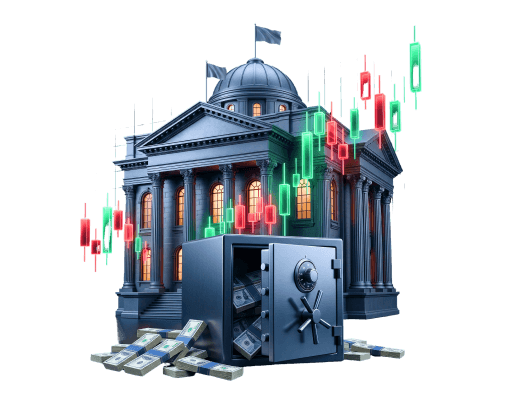
Types and Evolution of Proprietary Trading Firms
Bank proprietary trading involves financial institutions trading stocks, bonds, and derivatives with their own money rather than on behalf of clients. Historically, large investment banks dominated this space.
Trades internal balance sheet capital.
Operates outside large banking entities.
Provides virtual capital to individuals.
Regulatory shifts transformed how these institutions operate, shifting focus toward market-making and capital efficiency. This era birthed independent proprietary trading firms that operate without depositor risks. Modern prop trading heavily relies on algorithmic trading and complex quant strategies, replacing the traditional discretionary trader who relied on intuition. A quantitative trader today uses statistical models and rigorous risk controls to manage exposures. We also see the rise of retail proprietary trading firms, which provide virtual capital to individuals based on strictly monitored performance data.

Operations and Structure of Proprietary Trading
Institutional trading desks operate under strict organizational models designed to separate client execution from internal strategies. Proprietary trading firms establish direct market access to execute high-frequency trades with minimal latency. Traders engage in directional trading, betting on price movements, while other desks focus exclusively on arbitrage.
The precise distribution of firm capital to specific traders or automated strategies based on calculated risk-adjusted return metrics.
Every strategy requires exact capital allocation approved by risk committees. Traders face rigid risk management rules enforced by automated systems. Algorithms monitor position limits in real time, immediately liquidating accounts if they breach maximum drawdowns or specific loss thresholds. Heavy regulation dictates these operational models to prevent systemic risks. Desks operate in silos to protect proprietary algorithms and prevent information leakage across the broader financial institution.
Comparison with Other Trading Models
Understanding the differences between institutional players clarifies how market liquidity functions. When evaluating prop trading vs. hedge funds, the primary distinction is the source of money. Hedge funds manage external client money and charge management fees, while prop desks trade the firm internal balance sheet.
| Feature | Prop Trading | Hedge Funds |
| Capital Source | Internal Firm Money | External Investors |
| Risk Tolerance | Strict Drawdown Limits | Variable by Mandate |
Examining prop trading vs. sales & trading at large banks reveals that sales desks primarily facilitate client orders and earn commissions, taking less direct market risk. Modern desks feature a high degree of automation, requiring specialized trader/developer roles to build systems. Quantitative traders write programming scripts to execute high-frequency trading strategies, leaving less room for discretionary traders. Both models use diverse trading instruments, but capital deployment strategies differ based on internal risk appetite rather than external client mandates.
Challenges and Benefits of Prop Trading
Operating a prop desk presents unique operational hurdles. Traders work in a notoriously stressful environment where performance is quantified down to the millisecond. Institutional training programs often require junior staff to pass a rigorous evaluation course using simulated trading before touching live capital.
- High profit split potential
- Access to institutional tech
- No external client management
- Intensely stressful environment
- Strict maximum daily loss rules
- High job insecurity
Firms demand a proven track record of consistent returns while strictly adhering to trading objectives. Automated trading systems handle execution, but humans must constantly adjust algorithmic parameters to adapt to changing market conditions. Risk management is absolute. Hitting a maximum daily loss or an absolute maximum loss limit often triggers immediate system lockouts. Successful traders receive a lucrative profit split, keeping a significant percentage of their generated revenue, which heavily offsets the intense pressure of daily performance quotas.
Work Environment and Compensation
The culture on a trading floor is highly quantitative and meritocratic. Traders rely heavily on massive streams of data to refine their algorithms. While the front office takes the spotlight, the entire ecosystem depends on robust support functions.
Profits validate algorithms, but rigorous risk management guarantees survival in unpredictable market cycles.
Teams in operations, finance, and the back office ensure trades settle correctly, while compliance officers monitor regulatory adherence. The required technology infrastructure costs millions, emphasizing speed and reliability. Compensation relies almost entirely on performance-based arrangements. Base salaries exist, but the vast majority of income stems from a direct profit-sharing arrangement tied to desk revenue. This pure metric-driven approach minimizes office politics, as success is clearly defined by the daily profit and loss ledger managed by HR and desk heads.
Careers and Recruiting in Proprietary Trading
Securing a position at a top-tier desk requires exceptional analytical capabilities. Most candidates seeking entry-level roles possess a technical degree in physics, mathematics, or computer science. The interview process for a quant trader is notoriously rigorous.
Interview Stages
Candidates typically face mental math tests, programming whiteboard sessions, and complex market logic evaluations.
Candidates face rapid-fire mental math tests, complex brainteasers, and intensive probability theory assessments. Technical rounds require writing programming code on a whiteboard to solve algorithmic puzzles. Reviewing specific market case studies is standard practice to test logical reasoning under pressure. Previous internship experience provides a significant advantage. Experienced professionals often rely on a specialized headhunter or a direct internal referral to access lateral hiring opportunities. Building a strong professional network remains vital for discovering unadvertised roles in highly secretive firms.
Exit Opportunities and Career Progression
Career trajectories within these institutions follow a clear path based purely on trading results. An individual typically starts as an assistant trader or junior trader, focusing on execution and system monitoring. Consistent profitability leads to a senior trader position with increased capital allocation. The ultimate goal is becoming a partner at an independent proprietary trading firm, sharing in the global firm profits.
Traders who choose to leave find robust exit opportunities. Some transition to a specialized commodities firm or take roles as a market analyst. Others pivot entirely to technology companies, applying their high-level programming skills. Leaving early often requires forfeiting deferred compensation tied to a strict vesting period. Strategic networking ensures smooth transitions whether moving to a broker or launching a proprietary algorithmic fund.
Frequently asked questions
-
What was the impact of the Volcker Rule on bank proprietary trading?
The rule restricted deposit-taking banks from conducting certain proprietary trading activities, forcing many large institutions to spin off these desks into independent firms. -
How do quantitative traders differ from discretionary traders?
Quantitative traders rely on statistical models and automated algorithms to execute trades, whereas discretionary traders make manual decisions based on market analysis and intuition. -
What degree is typically required to secure a quantitative trading role?
Firms generally require a highly technical degree in fields such as mathematics, physics, computer science, or quantitative finance. -
How do proprietary trading desks manage market risk?
Desks implement automated risk controls that monitor position limits in real time, triggering immediate system lockouts if accounts reach maximum daily loss thresholds. -
Why do independent proprietary firms offer profit-sharing arrangements?
Because traders deploy the firm internal capital, compensating them with a direct split of the profits they generate incentivizes high performance while aligning interests.
Crypto guides
Beginner-frendly
The Informational Guide to Trading Mechanics Understand the foundational concepts, systems, and structures that drive global financial markets
 Farouk Ahmed
|
Farouk Ahmed
|
Intraday Trading Mechanics Analyzing the technical execution, risk parameters, and software infrastructure behind daily market operations.
 Alexey Morozov
|
Alexey Morozov
|
How to Put Day Trading Profits Under an EIN An objective breakdown of transitioning from retail market participation to operating a structured commercial entity.
 Oliver Grant
|
Oliver Grant
|

Our website uses cookies. Our Cookie Policy