


Commodity Trading Explained
A comprehensive guide to understanding global resource markets, price drivers, and financial instruments.
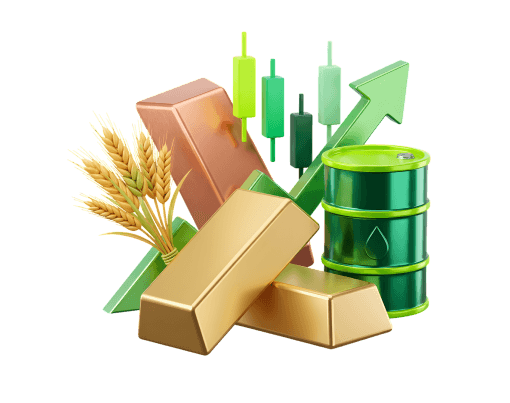
Types of Commodities
Physical goods drive daily human activity and form the foundation of global trade. The market divides these resources based on their origin. Hard commodities require extraction or mining. This includes industrial metals like copper and aluminum, alongside precious metals like gold and silver. The energy sector fits this classification, encompassing fossil fuels such as natural gas, Brent crude, and WTI crude. Soft commodities rely entirely on agriculture. They are grown or reared rather than mined from the earth. This category covers agricultural products and crops like wheat, coffee, and cotton. Livestock and meat, such as lean hogs and live cattle, also belong to this group.
Mined materials like copper and gold.
Grown goods like wheat and coffee.
Extracted resources like natural gas.
These resources are categorized by their production methods:
- Extracted resources form the baseline of industrial manufacturing and power generation.
- Grown goods depend heavily on natural life cycles and regional climate conditions.

How Commodity Markets Work
Understanding the mechanics requires looking at how buyers and sellers interact on a massive scale. Assets traded on major exchanges are mass-produced and standardised to ensure uniform quality and quantity across all transactions. Supply and demand dictate commodity prices across the entire global economy. Agricultural markets experience unique cycles tied directly to physical production and harvesting. Seasonality plays a significant role, as harvest forecasts often trigger immediate commodity price movement. Market participants analyze these variables to decide whether to go long or short depending on their specific outlook.
| Producers | Physical goods | Looking to lock in stable prices |
| Speculators | Financial instruments | Providing essential market liquidity |
Participants operate within specific commodity market hours determined by individual exchanges.
- Producers sell contracts to secure guaranteed pricing for their upcoming harvests or mining yields.
- Speculators absorb price risks from producers in exchange for potential market gains.
Factors That Move Commodity Prices
Asset values fluctuate based on complex global forces. Supply and demand remain the primary drivers, but external variables complicate the equation. Macroeconomics and the broader global economy dictate industrial consumption rates. Inflation often pushes raw material values higher as consumer purchasing power declines. Geopolitical events and geopolitical instability regularly disrupt established supply chains, particularly for international energy exports. Political events and policies, such as tariffs or trade embargoes, can instantly alter market access.
Unexpected climate events can destroy harvests overnight. This sudden reduction in supply frequently causes immediate upward pressure on agricultural asset values.
Market events and localized environmental issues also shift baseline availability.
- Long-term trends often stem from major demographic shifts and widespread technological adoption.
- Seasonality factors and unpredictable weather dramatically impact total crop yields year over year.
Commodity Futures and Spot Markets
Different financial instruments provide varying types of market access. The spot market facilitates immediate delivery, meaning the underlying asset changes hands almost immediately after the transaction clears. In contrast, futures contracts obligate participants to buy or sell at a predetermined future date, forming the basis of commodity futures. These structured agreements are regulated heavily by oversight bodies like the Commodity Futures Trading Commission. Traders frequently use margin loans to control larger positions with smaller capital outlays, which amplifies exposure to inherent market volatility.
Contract Settlement
Physical delivery requires receiving the actual goods, while cash settlement simply transfers the financial difference between the opening and closing transaction prices.
Contracts eventually reach their scheduled expiry, leading to final settlement procedures.
- Options commodities trading grants the right, but not the obligation, to execute a transaction at a set price.
- CFD trading and spread betting allow individuals to speculate on price directions without ever owning the actual materials.
Ways to Trade Commodities
Market participants have multiple vehicles for gaining exposure to these resources. Holding physical commodities like gold bars is the most direct method, though it requires securing appropriate storage and insurance. Indirect exposure comes through acquiring commodity stocks or broader commodity-linked stocks tied to major mining or agricultural corporations. Mutual funds and commodity ETFs pool retail capital to invest heavily in specific resource sectors. Exchange-traded notes act as unsecured debt securities designed to closely track spot prices or broad market indexes.
Allocating capital to physical resources can provide a robust buffer against traditional equity downturns, though it requires specific knowledge of global supply chains.
Traders seeking leverage often turn to derivative markets rather than traditional share dealing.
- Commodity exchanges facilitate the continuous buying and selling of standardized futures contracts and complex commodity options.
- Spread betting and CFD trading provide alternative mechanisms to speculate on short-term price changes.
Finding Commodity Trading Opportunities
Identifying potential market entries requires systematic evaluation of data. Fundamental analysis evaluates the core supply and demand imbalances, processing information from breaking news, harvest reports, and government data releases. Technical analysis focuses entirely on historical market prices and recorded volume data. Traders actively look for recurring price patterns on charts to predict probable future movements. Technical indicators like Bollinger Bands and the MACD help pinpoint short-term momentum shifts and potential trend reversals.
Combining analytical approaches often yields a clearer, more comprehensive market picture.
- Expert analysis provides necessary context for complex geopolitical shifts directly affecting the current commodity spot price.
- Trading signals generated by algorithmic systems highlight immediate momentum changes across multiple asset classes.
Risks and Benefits of Commodity Trading
Market exposure introduces a unique set of advantages and dangers. Institutional players often use these assets for portfolio diversification due to their historical negative correlation with traditional equities. Precious metals frequently act as reliable safe-haven assets during periods of extreme economic turbulence, while energy and agriculture serve as highly effective inflation hedging tools. Traders can open a long position if they expect rising values or open a short position if they anticipate a sharp decline.
- Potential inflation hedge
- High market liquidity
- Exposure to extreme volatility
- Complex geopolitical risks
These financial instruments carry inherent dangers that require careful navigation.
- Extreme volatility and sudden price movement can trigger rapid losses, especially when utilizing highly leveraged futures contracts.
- Practicing in a simulated demo account helps build familiarity before risking real capital on CFD trading or advanced hedging strategies.
Risk Management in Commodity Trading
Protecting capital is the absolute foundation of any sustainable risk-management strategy. High exposure to commodities magnifies both potential financial gains and subsequent losses. Speculation requires strict emotional discipline, especially when using margin loans to amplify buying power. Defining an exact position size before entering the market prevents a single poor decision from devastating an otherwise diversified portfolio.
Market mechanics provide built-in tools for actively limiting downside scenarios.
- A stop-loss order automatically closes a failing trade at a predetermined level to prevent further capital erosion.
- A take-profit order or limit order strictly secures unrealized gains once a specific target threshold is reached.
Active monitoring trades allows for real-time adjustments as underlying global conditions shift. Proper planning ensures that short-term profit and loss fluctuations do not derail long-term financial objectives, allowing participants to effectively hedge against broader macroeconomic uncertainties.
Frequently asked questions
-
What is the difference between hard and soft commodities?
Hard commodities are mined or extracted from the earth, including industrial metals, precious metals, and energy resources like crude oil. Soft commodities are agricultural products that are grown or raised, such as wheat, coffee, cotton, and various types of livestock. -
How do commodity futures work?
A futures contract is a binding agreement to buy or sell a specific quantity of a commodity at a predetermined price on a set date in the future. They are used by producers to lock in prices and by speculators to gain market exposure without handling physical goods. -
Why are commodity markets highly volatile?
Prices fluctuate rapidly due to external factors that suddenly disrupt global supply and demand. Unpredictable variables such as extreme weather conditions, geopolitical instability, supply chain bottlenecks, and changing government trade policies all contribute to rapid and severe market movements. -
Can I trade commodities without taking physical delivery?
Yes, most modern market participants use financial derivatives rather than taking physical delivery. Instruments such as futures, options, exchange-traded funds, and cash-settled contracts allow traders to speculate on price direction without needing to transport, store, or insure physical goods. -
What drives supply and demand in these markets?
Demand is typically driven by macroeconomic conditions, widespread industrial growth, and shifting consumer behavior. Supply depends heavily on production yields, mining output capacities, and seasonal weather conditions. Any imbalance between these two primary forces directly impacts global asset pricing.
Crypto guides
Beginner-frendly
How Much Can You Make Day Trading Stocks? An objective look at capital requirements, hidden costs, and the realities of daily market operations.
 Alexey Morozov
|
Is Insider Trading Legal in Russia? A Global and Comparative Regulatory Guide
 Oliver Grant
|
The Realities of Intraday Trading Analyzing Learning Curves, Software Mechanics, and Strategy Execution
 Farouk Ahmed
|

Our website uses cookies. Our Cookie Policy