

Solana Price History:
Understanding the Highs and Lows

The cryptocurrency market thrives on rapid changes driven by numerous economic and technological factors. Solana, a high-performance Layer-1 blockchain platform, has attracted significant attention for its exceptional transaction speed and low operational costs. Analyzing the price history of its native token, SOL, provides valuable insight into its market performance and future potential.
The Rise of Solana in the Crypto Space
Solana rose to prominence by addressing the scalability challenges that limited earlier blockchain networks. Its unique Proof of History (PoH) consensus mechanism, combined with Proof of Stake (PoS), enables exceptionally fast and affordable transactions. The Solana Foundation, a non-profit organization, promotes the blockchain's adoption and development to help it compete in a rapidly evolving digital asset market.

Key Milestones in Solana’s Value History
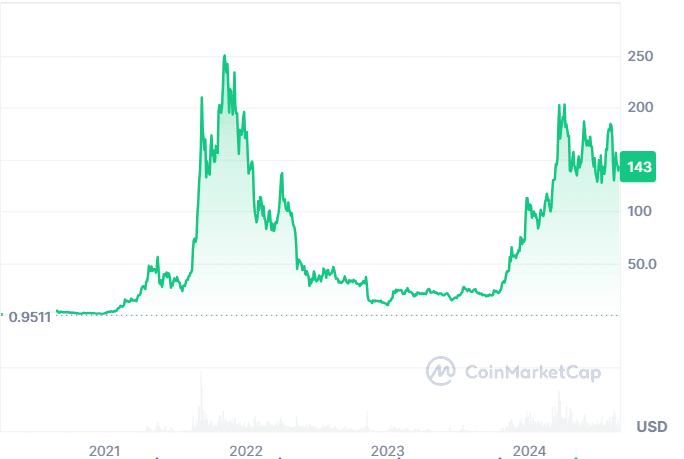
Following its mainnet beta launch in March 2020, Solana quickly gained traction for hosting decentralized applications and smart contracts. The blockchain's ability to process thousands of transactions per second made it a compelling choice for scalable projects. Consequently, the value of SOL surged during the crypto bull run, reaching an all-time high of nearly $260 in November 2021.
How Staking Influenced Solana’s Value Over Time
Staking plays a vital role in Solana's ecosystem and network security. By allowing token holders to delegate their SOL to validators, the Proof of Stake mechanism secures the blockchain and validates transactions. In return, stakers earn rewards, creating an incentive to hold the token long-term. This process increases demand for SOL and reduces its circulating supply, positively influencing its market value.
Solana Today: A Deep Dive into Solana’s Current Market Position
Solana maintains a strong position in the cryptocurrency landscape, consistently ranking among the top digital assets by market capitalization. It remains a preferred platform for developers and investors due to its robust technology, especially for projects requiring high throughput, such as decentralized finance (DeFi) protocols and non-fungible tokens (NFTs). Despite market-wide price fluctuations, the Solana Foundation's ongoing support ensures the ecosystem remains highly competitive.
Price of Solana, Market Cap, All-Time-High and All-Time-Low
The price of SOL reflects a volatile but significant journey in the crypto market. The asset reached an all-time high of approximately $260 in November 2021 and an all-time low of around $0.50 in May 2020. This wide range highlights its rapid early growth and the inherent volatility of the cryptocurrency sector. Its market capitalization consistently places it among the leading digital assets globally.
What Makes Solana Unique Among Other Blockchains?
Solana's key distinction is its hybrid consensus model. Proof of History is not a standalone consensus mechanism but a method for creating a verifiable, trustless source of time before consensus occurs. This timestamping system allows network nodes to agree on the order of events without messaging each other, drastically reducing processing time. When combined with a Proof of Stake protocol for validation, the result is one of the fastest and most efficient blockchains available.
The Role of Crypto in Solana’s Market Evolution
The growth of the broader cryptocurrency market served as a major catalyst for Solana. As interest in DeFi, NFTs, and scalable decentralized applications expanded, Solana emerged as a leading Layer-1 platform due to its high throughput and minimal fees. The Solana Foundation fostered this adoption by supporting developer initiatives. Furthermore, integration with major crypto exchanges and Web3 wallets improved accessibility, contributing to greater retail and institutional demand.
Solana vs. Other Cryptocurrencies: A Comparative Analysis
Compared to other major smart contract platforms like Ethereum, Solana offers distinct advantages in speed and operational cost. Its hybrid consensus model allows for a theoretical throughput of up to 65,000 transactions per second, far exceeding that of many competitors. This performance, combined with fractional-cent transaction fees, makes it a popular alternative for developers building high-volume applications like Web3 gaming and decentralized exchanges.
The Future of Solana: Predicting Solana’s Next Moves in Crypto
The future of Solana revolves around ongoing development focused on enhancing network performance, security, and decentralization. The Solana Foundation continues to fund ecosystem growth alongside planned protocol upgrades. Projects like Firedancer, an independent validator client designed to improve efficiency and software resiliency, signal a commitment to long-term scalability. While macroeconomic factors make price predictions difficult, the blockchain's strong fundamentals suggest it will remain a crucial industry layer.
Why SOL Is a Game-Changer in the Crypto Industry
SOL serves as a foundational asset by enabling a new class of decentralized applications that were previously impractical on slower, more expensive blockchains. The network's high performance unlocked innovation in areas such as high-frequency trading on decentralized exchanges, fully on-chain gaming, and large-scale NFT mints. This technical capability steadily drives demand for the token, cementing its status as a vital component for a high-speed decentralized web.
Solana’s Volatility: What Drives Solana’s Market Fluctuations?
Like all digital assets, the price of SOL experiences high volatility. Its market fluctuations stem from several factors, including broader cryptocurrency market sentiment, global regulatory news, and technological developments within the Solana ecosystem. Historical network performance issues and occasional outages have also influenced investor confidence. As a leading blockchain, Solana remains closely watched, meaning both positive adoption metrics and technical setbacks immediately impact its valuation.
The Impact of Crypto Market Trends on Solana’s Value
Solana's value closely correlates with broader crypto market cycles. During bull markets, SOL historically demonstrated strong performance, often outpacing other major cryptocurrencies due to massive retail interest in its high-performance ecosystem. Conversely, during bear markets or periods of macroeconomic uncertainty, its value can decline sharply alongside the rest of the market. While the Solana Foundation builds long-term resilience through developer retention, the price of SOL remains heavily tied to overall industry liquidity and trends.
Solana’s Position Among the Leading Cryptocurrencies
Solana holds a commanding position in the competitive landscape of smart contract platforms. It competes directly with Ethereum, its ecosystem of Layer-2 scaling solutions, and other high-performance Layer-1 networks. Its primary advantages remain its sheer speed, minimal costs, and a single, unified state machine that avoids the liquidity fragmentation associated with Layer-2 rollups. A highly active developer community helps maintain this leadership position and continually attracts new capital.
Solana’s Technological Advancements and Their Impact on Value
Solana's market value heavily depends on continuous technological advancements. Beyond its foundational Proof of History mechanism, the ecosystem evolves constantly. Core protocol upgrades aim to increase transaction throughput, optimize hardware requirements for validators, and improve overall network stability. These ongoing engineering efforts are crucial for attracting developers building next-generation applications and reinforcing investor confidence in the long-term viability of the platform.
A Comprehensive Look at Solana’s Price History in the Crypto Era
The price history of Solana charts a remarkable journey from its initial exchange offerings. Launching at a fraction of a dollar in early 2020, it captured market attention with its innovative architecture, leading to a parabolic rise to its all-time high in late 2021. This explosive growth paralleled the rapid expansion of its DeFi and NFT ecosystems. While the asset faces ongoing market volatility, the historical performance of SOL demonstrates its capacity for substantial growth when technical execution aligns with user demand.
Conclusion
Solana has established itself as a top-tier digital asset by delivering exceptional block times and fostering a vibrant developer ecosystem. As the broader blockchain market matures, ongoing protocol advancements and growing enterprise adoption point to a sustainable future. The platform is exceptionally well-positioned to function as a cornerstone of the decentralized economy, maintaining the potential to reach new milestones in both network utility and market value.
Frequently asked questions
-
What is Solana (SOL)?
Solana is a high-performance Layer-1 blockchain platform designed for scalable decentralized applications and cryptocurrencies. Its defining features are extremely high transaction speeds and minimal network fees. -
What makes Solana's technology unique?
Solana relies on a unique Proof of History (PoH) mechanism that creates a verifiable timestamp for transactions before processing. Combined with a Proof of Stake (PoS) consensus protocol, it allows the network to process thousands of transactions per second securely. -
When did Solana (SOL) reach its all-time high?
The native token, SOL, reached its all-time high price of approximately $260 in November 2021. -
What are the main use cases for the Solana blockchain?
Solana is primarily used for building high-performance decentralized applications. Its most popular use cases include decentralized finance (DeFi) protocols, non-fungible token (NFT) marketplaces, and Web3 gaming, where speed and low costs are essential. -
Who supports the development of the Solana network?
Initially developed by engineers at Solana Labs, the ecosystem is now heavily supported by the Solana Foundation, a non-profit organization focused on network growth, development, and decentralization.
Crypto guides
Beginner-frendly
Solana Price Prediction: Detailed SOL Price Forecast
 Roman Klochko
|
Roman Klochko
|
Solana (SOL): Revolutionizing Blockchain Technology
Roman Klochko
|
Solflare and Solana: A Perfect Match for Seamless Wallet Access
Roman Klochko
|

Our website uses cookies. Our Cookie Policy